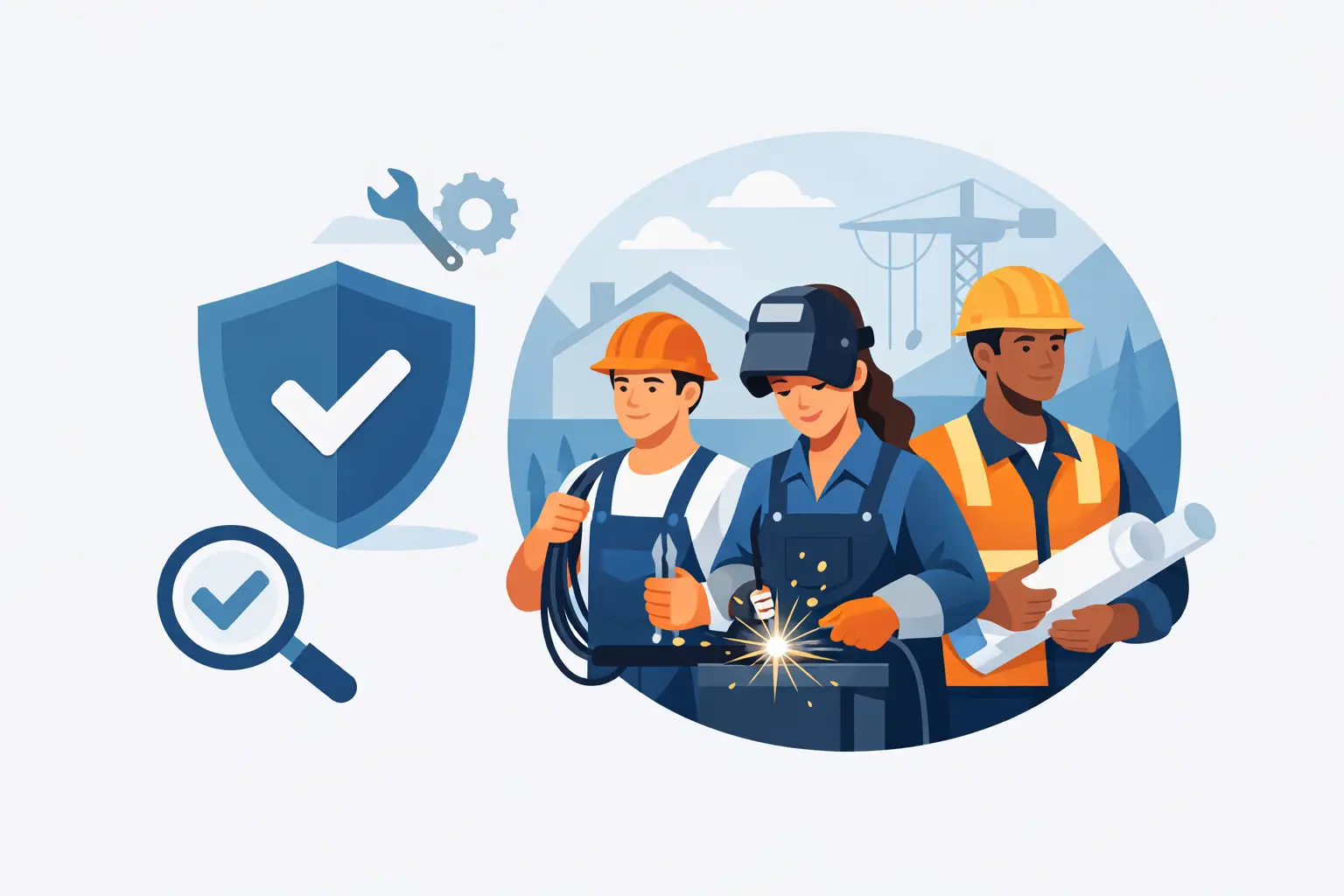
A resume says someone is an electrician. A verified profile shows the license, work history, completed projects, and whether that person can actually step onto a jobsite ready to perform. That is the real difference with verified skilled trades workers, and it matters more than ever when timelines are tight, labor is scarce, and one bad hire can throw off an entire project.
Construction hiring has always moved fast, but speed without trust is expensive. Employers need people who can show up, work safely, and produce at the level the job requires. Tradespeople need a way to prove they are more than a job title in a crowded market. Verification closes that gap.
What verified skilled trades workers actually mean
In the trades, verification is not just a box checked during onboarding. It is the process of confirming that a worker's credentials, employment history, and trade experience are real and current. Depending on the role, that can include licenses, certifications, identity checks, background screening, references, and evidence of completed work.
That distinction matters because not every trade job requires the same proof. A licensed electrician or plumber may need formal state credentials. A carpenter or mason may stand out more through project history, employer references, and a strong portfolio. An HVAC technician may need a mix of both. Verification should match the realities of the trade, not force every worker into the same template.
For employers, this creates a more reliable hiring signal. For workers, it creates a stronger professional profile. Instead of relying on claims, both sides can make decisions based on documented proof.
Why employers are prioritizing verified skilled trades workers
Every hiring manager in construction knows the hidden cost of uncertainty. You post a role, sort through applicants, chase references, and hope the person who looked good on paper can handle the field conditions, crew expectations, and production pace. If they cannot, the cost hits quickly through delays, rework, overtime, and lost momentum.
Verified skilled trades workers reduce that uncertainty early. When licenses are confirmed, employment history is validated, and past work is visible, the screening process gets shorter and the hiring decision gets stronger. That does not remove all risk. A verified welder can still be the wrong fit for a specific crew or schedule. But it gives employers a much better starting point than a generic profile with no proof behind it.
This is especially valuable for project-based staffing. Contractors often need to ramp up quickly for a new phase, replace a worker who dropped off, or fill specialized roles without waiting through a long recruiting cycle. In those cases, verification is not just about quality control. It is a speed tool.
There is also a safety and compliance angle. On many jobsites, especially commercial and industrial work, documentation matters. Hiring a worker with unclear credentials can create exposure that extends beyond productivity. Verified information helps employers protect the project as well as the schedule.
Why verification helps workers win better jobs
Good tradespeople lose opportunities every day because they are being compared in the same stack as unproven applicants. When everyone can write "10 years of experience" on a profile, experience by itself stops carrying much weight. What stands out is proof.
That is where verification changes the game for workers. A verified profile tells employers that the basics have been checked. A portfolio adds another layer by showing actual projects, not just job titles. Ratings, references, and validated work history help translate years in the field into something visible and credible.
This matters for more than landing any job. It matters for landing better jobs. Higher-paying employers, specialty contractors, and firms with repeat work often want confidence before they start a conversation. Workers who can present verified experience are more likely to move past the first filter and into serious hiring discussions.
It also supports career growth. A plumber trying to move from service work into larger commercial jobs, or a carpenter looking to step into a lead role, needs more than a basic application. Verified information helps show progression, reliability, and professional readiness.
The hiring process is changing
The old model of trades hiring still exists. A lot of work is filled through referrals, text messages, and last-minute calls. That system can work, especially for trusted local networks. But it also breaks down when companies need scale, speed, or a broader talent pool.
Digital hiring tools are changing expectations on both sides. Employers want faster candidate review, better matching, and less manual verification. Workers want mobile access, direct communication, and a way to present their experience professionally without building a white-collar style resume that misses what matters in the field.
That shift is why trade-specific platforms are gaining ground over generic job boards. In construction, hiring is not just about keywords. It is about license status, trade specialization, availability, geography, and proof of jobsite performance. A system built around those realities can do more than collect applications. It can surface qualified people faster.
AI-powered matching can help here, but only when the data behind it is credible. Matching gets more useful when worker profiles are verified and role requirements are trade-specific. Otherwise, the process just automates noise.
What employers should look for beyond the verified badge
Verification is a strong signal, but it should not be the only one. The best hiring decisions still combine proof with context.
A worker may be fully verified and still not be right for your project type, shift schedule, or crew dynamics. A commercial electrician with strong credentials may not be the best fit for residential service work. A mason with great project history may not be available when your phase starts. Verification improves the quality of the pool, but fit still matters.
That is why employers should look at the full picture - trade specialization, recent project experience, work samples, communication responsiveness, and location. If the platform supports direct messaging and portfolio review, those tools should be part of the decision process, not extras.
The strongest hiring workflows move in a clear order. First, confirm the worker is real and qualified. Then check whether their experience matches the job. Then move quickly to communication and scheduling. When those steps happen in one place, hiring gets faster without becoming careless.
How workers can make verification work for them
For tradespeople, verification should not feel like paperwork for someone else's benefit. It is a competitive advantage. The more complete and current your profile is, the easier it becomes for employers to take you seriously.
That means keeping licenses up to date, adding recent projects, showing specialties clearly, and responding quickly when opportunities come in. If you have certifications, add them. If you have photos of completed work, use them. If you have strong references or ratings, make sure they are visible.
There is a balance, though. Workers should not be buried under unnecessary admin tasks just to apply for a job. The best systems make verification practical and mobile-friendly. They respect that most tradespeople are not sitting at a desk. They are on jobsites, in trucks, or moving between calls.
When verification is handled well, it does not slow workers down. It helps them get seen, trusted, and hired faster.
Where platforms fit into the picture
This is where a specialized hiring platform can create real value. Instead of forcing construction hiring into a generic recruiting model, the right platform is built around the actual needs of field-based work - verified profiles, portfolio-driven candidate presentation, direct employer-worker communication, and matching that understands the trade.
For employers, that means less time sorting through weak applicants and more time talking to qualified people. For workers, it means a better shot at jobs that fit their skills and career goals. A platform like go2work is designed around that exchange, with verification and trade-specific hiring tools doing the heavy lifting in the background.
The key is trust at scale. Personal referrals will always matter in construction. But as labor demand stays high and workforce movement continues, companies need a way to find trustworthy talent beyond their immediate network. Workers need a way to prove their value beyond word of mouth. Verified hiring infrastructure makes that possible.
The trades run on skill, reliability, and reputation. Verification turns those qualities into something employers can act on quickly and workers can use to move forward with confidence. In a market where every day counts, that is not a nice feature. It is the standard that hiring is moving toward.